

AI Chatbot vs. Live Chat Support: Which Saves More Money in 2026?

A practical comparison of software, staffing, implementation, scalability, and customer experience costs to help you choose the most economical support model.
The Short Answer: AI Usually Costs Less, but Context Matters
For routine, repeatable questions, an AI chatbot will usually cost less than live chat support in 2026. It can conduct many conversations at once, operate around the clock, and absorb increases in demand without requiring an equivalent increase in headcount. Once implementation costs are covered, the marginal cost of another automated conversation can be very low.
That does not mean replacing every human agent produces the greatest savings. A cheap answer that is inaccurate, irrelevant, or frustrating may trigger repeat contacts, refunds, abandoned purchases, negative reviews, and customer churn. Those losses rarely appear on a chatbot platform invoice, but they belong in the business case.
Live chat remains financially valuable when a conversation involves emotion, ambiguity, negotiation, substantial account value, or a complicated technical problem. A skilled representative may cost more per interaction yet save an at-risk customer, close a high-margin sale, or prevent an expensive mistake.
Key takeaway
AI normally wins on direct cost per routine conversation. Humans often win on complex resolution quality and revenue protection. For most growing businesses, the strongest return comes from using each where it has a clear economic advantage.
This distinction is especially important in ecommerce, where support influences both operating expense and conversion. As explained in these seven practical uses of AI in ecommerce, automation creates the most value when it removes repetitive work while preserving a good buying experience.
What AI Chatbots Really Cost in 2026
The subscription price is only one part of chatbot cost. A credible budget should include setup, integrations, testing, governance, maintenance, and the internal time required to improve the system. Modern generative AI can interpret flexible language and answer a wider range of questions than traditional menu-based bots, but it also introduces variable model usage and greater quality-control requirements.
The main chatbot cost categories
- Platform and AI usage: Monthly software subscriptions, conversation limits, model or token charges, premium analytics, and additional fees for advanced features.
- Implementation: Conversation design, prompt configuration, testing, interface customization, and project management.
- Integrations: Connections to order management, CRM, appointment, payment, ticketing, identity, or inventory systems.
- Knowledge preparation: Cleaning product information, support articles, policies, and internal procedures so the assistant can retrieve dependable answers.
- Security and compliance: Access controls, data-retention policies, vendor reviews, audits, redaction, and monitoring.
- Ongoing optimization: Reviewing unanswered questions, correcting weak responses, updating content, and tuning escalation rules.
Knowledge maintenance is particularly easy to underestimate. If return rules, product details, prices, or delivery estimates change, the chatbot’s source material must change too. Automation does not eliminate content ownership; it makes accurate content more operationally important.
The strongest chatbot economics appear at higher volumes. The same underlying system may serve hundreds or thousands of additional customers with no overtime, shift differential, or emergency recruitment. Seasonal retailers can therefore accommodate sudden peaks without maintaining year-round staffing for their busiest week.
A chatbot is not a one-time installation. Treat it as a continuously managed service whose value improves as its knowledge, integrations, and escalation logic improve.
Infrastructure choices also affect total cost. If customer support is being added during a larger store project, include it in the complete technology budget rather than evaluating it in isolation. This guide to the real cost of building an ecommerce website in 2026 provides useful context for distinguishing launch expenses from ongoing operating costs.
What Live Chat Support Really Costs in 2026
Live chat’s visible expense is employee pay, but its fully loaded cost is broader. It includes benefits, payroll taxes, recruitment, onboarding, training, supervision, quality assurance, scheduling, equipment, software seats, and the paid time agents spend in meetings or between contacts.
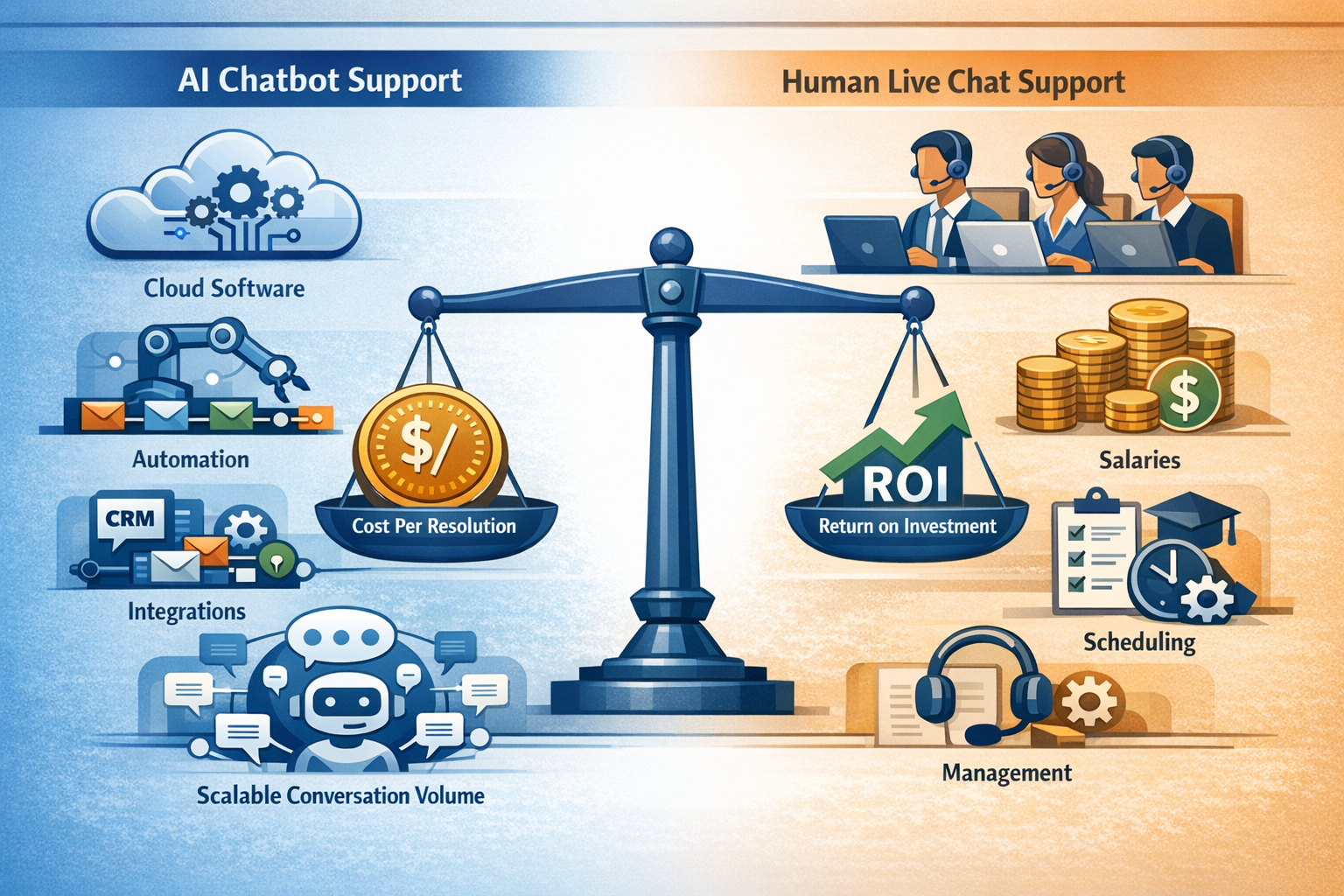
Agent concurrency can improve efficiency because a representative may handle more than one conversation at a time. However, concurrency is not unlimited. Two straightforward order-status chats may be manageable together; three complicated billing disputes may not be. As concurrency rises beyond a sensible level, response times lengthen, errors increase, and customers receive less thoughtful answers.
Coverage changes the calculation
A daytime team serving one market is simpler to operate than a multilingual, 24/7 service. Nights, weekends, holidays, absences, and demand surges require extra capacity. Businesses may build that capacity internally or outsource it, but either route adds management and quality-control work.
Human agents also create value that should be credited against their cost. They can recognize hesitation, adapt an explanation, make an appropriate exception, detect a product issue, identify fraud, or turn a service conversation into a sale. In conversational commerce, this ability is particularly useful. A well-designed process for turning WhatsApp conversations into checkout demonstrates how human-assisted chat can contribute directly to revenue.
| Cost factor | AI chatbot | Live chat |
|---|---|---|
| Scaling volume | Usually low marginal cost | Generally requires more labor capacity |
| 24/7 availability | Built into the operating model | Requires shifts or outsourcing |
| Initial setup | Knowledge, integrations, testing | Hiring, training, procedures |
| Complex judgment | Limited and must be governed | Strong when agents are experienced |
| Ongoing improvement | Content, prompts, evaluation | Coaching, QA, retention |
Cost-per-Resolution: The Metric That Reveals Real Savings
Cost per chat is attractive because it is easy to calculate, but it can reward the wrong outcome. If a customer receives a quick automated answer and returns twice because the issue remains unresolved, the business did not purchase one inexpensive interaction. It funded three contacts and created additional customer effort.
A better core metric is cost per successful resolution. Start with all relevant technology and labor costs for a defined period, then divide them by the number of issues resolved without avoidable repeat contact.
Define “successfully resolved” before running a comparison. Depending on the business, it might mean no repeat contact about the same issue within seven days, completion of the desired self-service action, or customer confirmation that the answer solved the problem.
Metrics to evaluate together
- Containment rate: The percentage of chatbot conversations completed without human intervention.
- Escalation rate: The percentage transferred to an agent, segmented by reason.
- First-contact resolution: How often the issue is solved during the initial contact.
- Repeat-contact rate: How often customers return about the same problem.
- Average handling time: Agent time required, including work completed after the chat.
- Customer satisfaction: The customer’s assessment of the interaction and outcome.
Then add revenue effects. Measure support-assisted conversions, churn prevented, refunds avoided, abandoned carts recovered, and legitimate upsells. A solution that costs $1 less per resolution but reduces conversion or retention may be a false economy.
Where AI Chatbots Generate the Biggest Savings
AI delivers the clearest return when requests are frequent, predictable, supported by reliable data, and safe to automate. These conversations consume substantial agent capacity but generally do not require discretion.
High-value automation candidates
- Order status, shipment tracking, delivery windows, and store hours
- Password resets, account access guidance, and basic authentication
- Appointment booking, confirmation, rescheduling, and cancellation
- Product compatibility, availability, sizing, and policy questions
- Basic troubleshooting with clear, reversible steps
- Lead qualification and collection of contact or account details
Seasonal businesses gain another advantage: elastic capacity. A chatbot can absorb a sudden campaign spike without rushed recruitment and abbreviated training. Global companies can also provide basic multilingual assistance across time zones, although important translations and region-specific policies should be reviewed by qualified people.
Automation can save money even when it does not finish the conversation. A chatbot can authenticate the user, identify the intent, collect an order number, run preliminary diagnostics, and summarize the exchange. The receiving agent starts with context instead of spending the first several minutes gathering it.
Start with volume, not novelty
Rank contact reasons by monthly volume, handling time, and automation risk. The best first use case is usually a repetitive issue with clean source data—not the most impressive demonstration.
When Live Chat Is Worth the Higher Price
Human assistance is economically justified when judgment and trust materially influence the outcome. Anger, vulnerability, negotiation, or unusual circumstances can make a technically correct automated response feel inappropriate. A trained representative can acknowledge emotion, clarify uncertainty, and choose among options that do not fit a standard workflow.
Complex business-to-business products also favor human involvement. The agent may need to understand account history, technical dependencies, contractual terms, stakeholders, and commercial objectives. Similarly, high-consideration purchases benefit from consultative support that reduces uncertainty rather than merely retrieving facts.
Regulated or consequential situations deserve conservative escalation. Privacy requests, medical concerns, financial guidance, legal disputes, fraud indicators, and exceptions with significant financial impact may require a qualified person and a documented review process.
The right question is not “Can AI answer this?” It is “What is the cost of an inadequate answer, and is automation permitted to carry that risk?”
Human chat may also protect conversion when site design or performance leaves customers uncertain. Support should not become a permanent workaround for a slow experience, however. Improving the underlying journey—including meeting sensible ecommerce site speed benchmarks—can reduce avoidable contact and increase sales simultaneously.
The Hybrid Model: How to Maximize ROI in 2026
A hybrid model uses AI as the first layer for discovery, routine resolution, and data collection while preserving a clear path to a person. It avoids paying human rates for repetitive work without forcing automation onto conversations where it is likely to fail.
A practical implementation sequence
- Establish a baseline. Record contact volume, cost per resolution, first-contact resolution, satisfaction, conversion, and retention before changing the support model.
- Group conversations by intent. Identify the most common questions and estimate their handling time, complexity, business value, and risk.
- Automate a narrow set first. Select well-documented, high-volume issues with objective answers and straightforward actions.
- Define escalation triggers. Transfer conversations based on negative sentiment, repeated failed answers, account value, purchase intent, compliance risk, or explicit customer request.
- Give agents context. Pass the transcript, customer details, detected intent, actions already attempted, and an AI-generated summary into the live chat workspace.
- Run a controlled pilot. Compare the hybrid group with the current process over a period long enough to capture repeat contacts and revenue outcomes.
- Expand only after validation. Add use cases when quality and financial targets are consistently met.
Customers should never need to fight the chatbot to reach a person. Offer escalation when confidence is low, after repeated misunderstanding, and whenever the customer asks. The handoff must be continuous: requiring people to repeat information erases much of the efficiency and goodwill the automated first layer was meant to create.
The operating model matters as much as the software. Assign owners for knowledge accuracy, automation performance, agent quality, security, and financial reporting. A managed recurring approach can make these responsibilities easier to budget, much as businesses compare monthly ecommerce plans with large upfront builds.
A sensible 2026 target
Aim to automate routine demand, not maximize containment at any cost. The winning system lowers total cost per resolution while maintaining or improving satisfaction, conversion, and retention.
Conclusion: Choose Based on Total Economic Value
AI chatbots generally save more money on repetitive, high-volume support because they handle simultaneous conversations, scale quickly, and provide continuous availability. Live chat costs more to operate, but its judgment, empathy, and commercial awareness can make it the less expensive option when a poor outcome would lead to churn, compliance exposure, or lost revenue.
Do not compare a software subscription with agent wages and call the analysis complete. Include implementation, integrations, knowledge maintenance, management, repeat contacts, customer satisfaction, and revenue effects. Above all, measure cost per successful resolution rather than cost per interaction.
For most businesses in 2026, the practical answer is hybrid: automate safe and predictable work, escalate complex or valuable conversations, and equip agents with the context needed to resolve issues efficiently.
Choose the Support Model That Reduces Cost Without Sacrificing Customers
Calculate your current cost per resolution, identify the highest-volume automatable conversations, and test a hybrid workflow against measurable financial and customer-experience targets. Start narrow, review the evidence, and expand only where automation improves the complete outcome.